
People Management
20 Ways To Stay Positive At Work (Even On Difficult Days)

When people think of having a positive attitude, they often picture surface-level happiness, like forcing a smile or trying to think positive thoughts.
But a positive attitude at work goes deeper than that. It shapes how you respond to challenges, interact with coworkers, and handle the day-to-day realities of your job. While negative attitudes tend to reinforce stress and frustration, a positive work attitude helps create a more productive, resilient, and focused environment.
And in the workplace, that matters. Deadlines, difficult conversations, and last-minute schedule changes are all part of the job. Without the right mindset, they can quickly lead to burnout or disengagement. With a strong, positive attitude, they become easier to manage.
Research consistently shows that workplace positivity is linked to better mental and physical well-being, improved job performance, and higher overall satisfaction. People with a positive attitude are more likely to see opportunities, adapt to change, and continue developing new skills day-to-day.
In this guide, you’ll find 20 practical positive attitude examples you can apply at work. You’ll learn how to stay positive in real workplace situations and build habits that support a more consistent, professional, and resilient mindset.
Key takeaways
- A positive attitude at work improves both job satisfaction and overall performance
- Small, consistent habits can help you maintain positivity, even during stressful workdays
- Workplace positivity comes from both mindset and environment, not just external factors
- Clear communication, better routines, and the right tools can reduce stress and support a more positive work experience
Table of contents
- The importance of a positive attitude in the workplace
- 20 positive attitude examples for the workplace
- How to improve your workday with When I Work
- There are many ways to keep a positive attitude at work
- Make it easier for your team to stay positive
- Keeping a positive attitude at work: FAQs
You know what makes it easier to stay positive at work? Well, it’s a lot easier to have a positive attitude when your day isn’t filled with unnecessary challenges, and when you remove the daily frustrations that drain your time and energy.
If you’re spending hours each week building schedules, chasing shift confirmations, or fixing last-minute changes, it’s much harder to maintain a positive work attitude.
Software like When I Work helps reduce those issues by simplifying scheduling, communication, and shift management, so you can focus on your team instead of the admin.
Try When I Work free and take hours of scheduling and communication off your plate each week.
The importance of a positive attitude in the workplace
Understanding the importance of a positive attitude in the workplace is the first step toward building a more resilient career. When you prioritize a positive attitude for work, you improve your performance and your team’s morale.
When it comes to the workplace, your attitude affects more than just how others perceive you. Attitude directly impacts your performance, your relationships, and your overall job satisfaction. Considering many of us spend around forty hours a week at work, your workplace attitude plays a major role in your day-to-day experience.
A positive attitude at work helps you stay focused, handle challenges more effectively, and communicate better with your team. It also makes you more resilient when things don’t go as planned, something that’s inevitable in any job.
Workplace positivity can influence everything from team dynamics to productivity. Employees with a positive work attitude are more likely to collaborate, adapt to change, and contribute to a healthier work environment.
Even if you don’t love every part of your job, maintaining a positive mindset can help you reframe challenges, manage stress, and stay engaged in your work.
20 positive attitude examples for the workplace

Maintaining a positive work attitude isn’t just a feeling but a set of behaviors. Here are 20 positive attitude examples you can use at work and actionable tips to help you stay focused and professional. These examples of a positive attitude show how small behaviors can shape your mindset, your relationships, and your performance at work.
Not every tip will apply to every role or situation. Focus on a few that feel realistic, and build from there.
1. Surround yourself with positive people
The people you spend time with at work have a direct impact on your mindset. If you’re constantly around coworkers who complain, gossip, or focus on what’s going wrong, it’s easy to fall into the same patterns. In the long run, that can negatively shape how you see your job and your workplace.
Instead, make an effort to connect with people who bring energy, ideas, and a more constructive outlook. Coworkers who enjoy their work, look for solutions, and stay engaged can help reinforce a more positive work attitude.
You won’t always be able to choose who you work with, but you can choose how you engage. If you’re in a more negative environment, avoid getting pulled into it. Step away when needed, take breaks, or shift your focus to conversations that are more productive.
Small choices like this can make a noticeable difference in how you maintain positivity at work every day.
Read also: How To Handle A Toxic Work Environment
2. Fill your mind with positive input
What you consume mentally has a direct impact on your attitude at work. Just like the people around you influence your mindset, the content you take in throughout the day shapes how you think, react, and approach your work. If your input is negative or draining, it becomes much harder to maintain a positive work attitude.
Look for small ways to introduce more positive input into your routine. That could mean listening to music that helps you focus, choosing podcasts or audiobooks that are encouraging or educational, or reading content that helps you build new skills.
Even a few intentional choices each day can shift your mindset.
If “you are what you eat” applies to your body, the same is true for your mind.What you take in is what you carry into your workday.
3. Control your language

This is not about policing what you say, but about being intentional with how you think and communicate at work.
The Sapir-Whorf hypothesis, popularized in the movie Arrival, suggests that the structure of language influences how we perceive the world. At its most extreme, it argues that language can even limit how we think.
Even in everyday situations, the language you use, both in your thoughts and in conversations, has a cumulative effect on your mindset. Your language shapes how you see your work, your coworkers, and the challenges you deal with.
For example, describing your day as “packed with tasks” can feel draining, while seeing it as “full of opportunities” creates a more constructive outlook. The situation has not changed, but your perspective has.
This also applies to how you communicate with your team. Clear, constructive language helps reduce misunderstandings and keeps everyone aligned, especially when you are using tools like team messaging to stay in sync throughout the day. When communication is consistent and positive, it becomes much easier to maintain a positive attitude at work across the team.
Pay attention to how you speak and think throughout the day. Small shifts in language can make a noticeable difference in how you maintain positivity at work.
4. Create a routine for the day
Routines often get a bad reputation. It can feel like having a routine means you’re stuck or not flexible.
In reality, routines create structure that makes it easier to stay focused and maintain a positive attitude. When you know what to expect from your day, you spend less time deciding what to do next and more time actually doing it.
A simple routine can help you prioritize your most important work, take breaks at the right time, and avoid burnout later in the day. For many people, the morning is when focus is highest, so it makes sense to tackle more demanding tasks early.
Toward the end of the day, shift to lighter work and prepare for tomorrow. Wrapping up loose ends and planning ahead helps you start the next day with clarity instead of stress.
Building consistent habits like this is one of the most effective ways of maintaining a positive attitude at work, especially in busy or unpredictable environments.
5. Be nice to other people
Being kind to others at work is one of the simplest ways to improve your own mindset.
Research has shown that doing something kind for someone else can boost your happiness in the same way as trying something new or exciting. Even reflecting on past acts of kindness can improve your overall sense of well-being.
In the workplace, this creates a ripple effect. Positive interactions tend to build on each other, while negative ones do the same. A single moment of appreciation, support, or patience can shift the tone of a conversation or even an entire shift.
If your work feels stressful or difficult, focusing on how you treat the people around you can help you maintain a positive attitude, even when the work itself is challenging.
Recognizing coworkers, offering help, or simply being respectful in your day-to-day interactions all contribute to stronger workplace relationships and a more positive work environment.
Small actions like these are practical examples of positive attitude in the workplace, and they help create a culture where positivity is the norm rather than the exception.
Bonus tip: To create a supportive, positive work atmosphere for everyone, check out team-building games. Activities that encourage collaboration can reinforce these behaviors and strengthen positivity across your team.
6. Don’t rely on an outside source of positivity

A positive attitude at work becomes much more sustainable when it’s not dependent on other people or ideal circumstances.
Some days will be smooth. Others will involve last-minute changes, difficult conversations, or unexpected problems. If your mindset depends on everything going well, it becomes hard to stay positive when those situations come up.
Instead, build simple habits that help you reset your mindset throughout the day. That could be taking a short break, stepping away from a stressful situation, or using a quick mental cue to refocus on what you can control.
The goal is to develop a consistent internal approach to handling challenges, rather than relying on external factors to determine how you feel.
Over time, that makes it easier to maintain positivity at work, even in unpredictable or high-pressure environments.
7. Create high points in each day and week
One of the most effective ways to stay positive at work is to have something to look forward to.
It doesn’t have to be a vacation or a major event. Small, intentional breaks or moments throughout the day can help reset your mindset and make demanding workdays feel more manageable.
Creating these ‘high points’ gives you a mental boost and helps break up long stretches of work. It’s also a simple way to maintain a positive attitude, especially during busy or repetitive periods.
A few simple ways to do this:
- Avoid relying on unhealthy rewards like junk food or excessive caffeine, which can lead to energy crashes later in the day
- Take breaks away from your workspace when possible, even if it is just for a few minutes
- Go for a short walk, sit in silence, or step outside to reset your focus
- Read something unrelated to work to give your mind a break
Daily high points should be small and easy to maintain without creating negative habits or extra expenses. Weekly or monthly high points can be a bit bigger, like planning a lunch out or scheduling something you enjoy after work.
When you build these moments into your routine, it becomes easier to maintain positivity in the workplace and stay engaged throughout the week.
8. Assume responsibility and choose your response
A positive attitude at work is closely tied to how you respond to situations, not just what happens to you.
When something goes wrong, it’s easy to focus on blame or feel like the situation is out of your control. But that mindset can quickly lead to frustration and negativity. Taking responsibility, even partially, helps you stay focused on what you can actually change.
A useful way to think about it is: event + response = outcome. You may not control the event, but your response always plays a role in what happens next.
In the workplace, this might look like staying calm when plans change, taking ownership of mistakes, or choosing to focus on solutions instead of problems. These small decisions help you maintain a positive work attitude, even in challenging situations.
This approach builds resilience and makes it easier to maintain positivity at work, rather than feeling stuck or reactive.
9. Decide your reaction to known problems ahead of time

Every workplace has recurring challenges. It might be a difficult client, a coworker who communicates poorly, or a task you know will be frustrating.
Instead of reacting to these situations in the moment, decide in advance how you want to handle them.
When you expect a problem, it becomes easier to stay calm and respond intentionally. For example, if a client frequently requests changes, you can plan to approach those conversations with patience instead of frustration. If a certain task is always stressful, you can prepare for it mentally and give yourself more time or structure around it.
The mindset shift helps you stay in control of your response, rather than letting the situation dictate your attitude.
This is a simple but effective way of maintaining a positive attitude at work, especially when dealing with repeated or predictable challenges.
It can also help to reframe how you see the people involved. A difficult interaction may have more to do with someone else’s stress or circumstances than anything personal. Taking that perspective makes it easier to stay professional and keep a positive work attitude.
10. Breathe deeply
One of the quickest ways to reset your mindset at work is to slow down and focus on your breathing.
When stress builds up, your body reacts automatically. Deep breathing helps interrupt that response by calming your nervous system and giving you a moment to pause before reacting. That pause can make a big difference in how you handle a situation.
If you notice your attitude starting to shift in a negative direction, step away for a minute if you can. Take a few slow, controlled breaths and give yourself time to reset. Even a short break like this can help you think more clearly, respond more calmly, and reduce stress.
Simple habits like this make it easier to maintain a positive attitude at work, especially during high-pressure or fast-paced moments.
If daily scheduling, shift changes, and team communication are adding unnecessary stress to your day, it might not be a mindset problem, it might be a systems problem.
When I Work helps teams stay organized, aligned, and up to date without the constant back-and-forth.
Start Your Free Trial Today!
11. Make a mission statement
Having a clear sense of purpose can make it much easier to maintain a positive attitude at work.
While your company likely has a mission statement, it helps to define one for yourself. They’re common across industries, from healthcare and retail to tech companies and nonprofits, where mission statements help guide decisions and culture.
A personal mission statement gives you a clear understanding of what you value, what you’re working toward, and how you want to show up in your role.
When work becomes stressful or unclear, it gives you something to come back to. Instead of feeling stuck or directionless, you have a reference point that helps guide your decisions and behavior.
Your mission statement doesn’t need to be complicated. It can be as simple as focusing on doing meaningful work, supporting your team, or continuing to grow in your role.
When you feel connected to a purpose, it becomes easier to stay motivated, focused, and positive. Without that sense of direction, it is much easier for frustration and negativity to take over.
12. Have personal goals

Personal goals give you direction, which makes it much easier to stay positive at work.
Unlike a mission statement, which defines your overall purpose, goals are specific outcomes you’re working toward. They give you something to focus on and something to measure progress against.
In the workplace, this might mean improving a skill, taking on more responsibility, or working toward a promotion. Even smaller goals, like getting through a busy week more efficiently, can create a sense of progress.
Without goals, it’s easy to feel stuck or disconnected from your work. That feeling can quickly impact your workplace attitude and make it harder to stay motivated.
When you have clear goals, you can see forward movement. That sense of progress is one of the most effective ways of maintaining a positive attitude at work.
13. Remember that no one owes you anything
Your expectations have a direct impact on your workplace attitude. If you expect coworkers, managers, or customers to behave a certain way, it’s easy to feel frustrated when they don’t. That frustration can quickly turn into negativity and make it harder to maintain a positive attitude at work.
A more effective approach is to focus on what you can control. When you take ownership of your actions and reactions, you’re less likely to feel stuck or reactive when things don’t go your way.
Instead of relying on external factors, try grounding your mindset in a few simple principles:
- It’s up to me to take action and move things forward
- Consistent effort matters more than immediate results
- I can adapt when situations change
- I can keep going, even when things are difficult
This kind of thinking helps you stay focused, reduce frustration, and maintain positivity without depending on everything going perfectly.
14. Stop complaining
We already talked about how language shapes your mindset, and complaining is one of the quickest ways to reinforce negativity.
It might feel like venting helps in the moment, but constant complaining keeps your focus on what’s wrong instead of what can be improved. That shift in focus can have a direct impact on your workplace attitude and how you experience your day.
If you’re around coworkers who complain frequently, it’s easy to fall into the same pattern. Try to step back from those conversations or redirect them toward solutions instead.
A more effective approach is to acknowledge the issue, then move on to what you can control or change. That mindset helps you maintain a positive attitude at work without ignoring real challenges.
See also: 5 Ways Employee Culture Impacts Your Bottom Line
15. Embrace laughter
Laughter is a simple way to reset your mindset and stay positive at work, even during stressful situations.
When something goes wrong, tension builds quickly. A well-timed moment of humor can break that tension, help people reset, and make challenges feel more manageable.
You don’t need to force it, but staying open to light moments throughout the day can make a big difference. Teams that can laugh together tend to communicate better and handle pressure more effectively.
It’s important to keep that humor respectful. Laugh with people, not at them. The goal is to create a more positive work environment, not make someone else the punchline.
16. Be curious and keep learning

A closed mindset makes work feel repetitive, frustrating, and harder than it needs to be. When you resist new ideas, feedback, or change, even small challenges can start to feel like problems.
Curiosity shifts that completely.
When you approach your work with a willingness to learn, new tasks become opportunities instead of interruptions. You start asking better questions, understanding processes more deeply, and finding smarter ways to do things.
That kind of mindset naturally supports a positive work attitude because you’re focused on growth instead of resistance.
It also keeps your workday more engaging. Whether it’s learning a new tool, understanding a colleague’s role, or improving a skill, curiosity keeps you moving forward, which is a key part of maintaining a positive attitude at work.
17. Focus on the long term
Short-term challenges are where most negative reactions come from. Deadlines, difficult conversations, or unexpected problems can feel overwhelming in the moment.
That’s where perspective matters.
When you step back and look at the bigger picture, those same challenges often feel more manageable. You start to see how today’s effort connects to long-term goals, career growth, or team success.
This shift helps you stay positive at work because you’re not reacting only to immediate pressure, you’re thinking in terms of progress.
It also leads to better decisions. Acting on short-term emotion often creates more problems, while a long-term view encourages calmer, more considered responses.
If you want a simple way to strengthen positivity in the workplace, this is one of the most effective habits to build.
18. Communicate clearly with your team
A lot of frustration at work doesn’t come from the work itself, but from miscommunication. When people aren’t aligned, small issues turn into bigger problems. Tasks get duplicated, deadlines slip, and uncertainty creeps in. That kind of environment makes it much harder to maintain a positive attitude.
Clear, consistent communication fixes most of this.
When everyone knows what’s happening, who’s responsible, and where to find information, the day runs more smoothly. You can focus on your own work without second-guessing what others are doing.
Using a shared system for scheduling and team messaging can make a big difference here. When communication lives in the same place as your schedule, it reduces confusion and keeps everyone aligned.
If your team relies on multiple tools, messages get lost. Bringing everything into one place helps support a positive work environment and a stronger workplace attitude across the team. Positive attitudes shape how teams communicate and perform, especially in fast-paced or shift-based environments.
19. Maintain a professional attitude (even when you have to fake it)

You won’t feel positive every day. No one does. But waiting to feel motivated or upbeat before taking action usually leads nowhere. In many cases, the action comes first, and the feeling follows.
Maintaining a professional attitude means driving your emotions rather than letting them drive you.
If you show up with energy, stay engaged, and approach your work with intent, your mindset often catches up. That’s one of the most practical ways of maintaining a positive attitude at work.
This isn’t about being fake or forcing constant enthusiasm. It’s about choosing behaviors that support the kind of attitude you want to have.
So if you’re not feeling your best, focus on what you can control: your tone, your effort, and how you respond to situations.
If you need a reset, it can also help to revisit simple habits that support your mood. For example, if you want to feel happier at work, small changes in your routine can often shift your mindset more than you expect.
20. Use tools that make work easier
If your day is full of repetitive, manual tasks, it’s much harder to stay positive.
Constantly rebuilding schedules, chasing updates, or managing communication across different tools adds unnecessary issues. That kind of workload drains energy and makes even simple tasks feel frustrating.
The right tools remove that pressure.
For example, scheduling software can automate shift planning, keep your team updated in real time, and reduce the need for constant back-and-forth. Instead of reacting to problems, you’re staying ahead of them.
That shift has a direct impact on your workplace attitude. When your systems support you, it’s easier to stay focused, organized, and in control of your day.
Tools like When I Work are designed to simplify scheduling and team communication in one place, helping you reduce admin time and create a more positive work environment for your team.
You don’t need to do everything manually. The more you remove repetitive work, the more space you create for better decisions, better communication, and a more positive attitude at work.
How to improve your workday with staff management tools like When I Work
One of the fastest ways to improve positivity in the workplace is to remove unnecessary challenges from the day.
When simple tasks feel difficult, like requesting time off, updating availability, or getting a clear answer from a manager, frustration builds quickly. That frustration affects your workplace attitude and spreads across the team.
The opposite is also true.
When systems are clear, fast, and reliable, people spend less time chasing information and more time doing meaningful work. That creates a more positive work environment without forcing it.
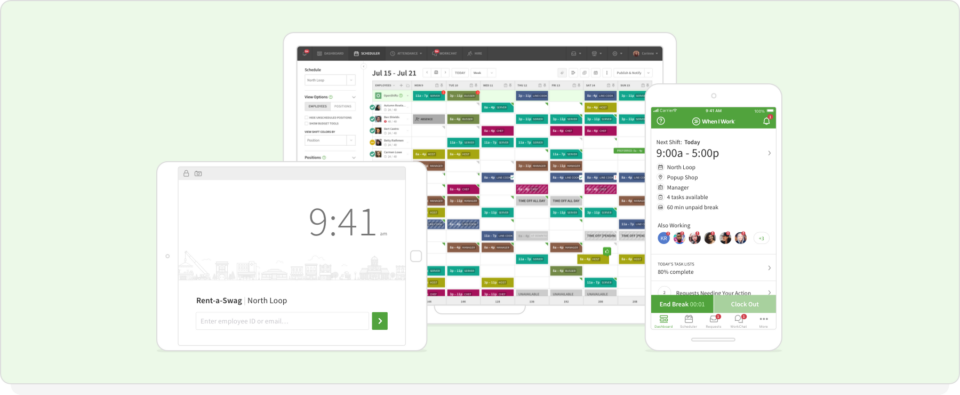
A workforce management tool like When I Work helps make that shift by bringing scheduling, communication, and availability into one place.
With the right system in place, your team can:
- Access the latest schedule anytime without confusion
- Swap or drop shifts without unnecessary back-and-forth
- Submit time-off requests and update availability easily
- Communicate with the team in a way that actually gets seen
It’s a simple change, but it has a direct impact on maintaining a positive attitude at work across the entire team.
There are many ways to keep a positive attitude at work
A positive work attitude isn’t something you achieve once and keep forever. It’s something you actively maintain.
The habits in this guide, from better communication to long-term thinking, all contribute to how you show up each day. Small actions build momentum, and that momentum shapes your overall experience at work.
You don’t need to apply everything at once. Start with a few that feel realistic, build consistency, and expand from there.
Building a positive attitude for work starts with consistent habits, not one-off changes. Because in the end, positivity at work is about choosing how you respond to challenges, again and again.
Make it easier for your team to stay positive
If you’re responsible for a team, your systems matter just as much as your mindset. Maintaining a positive attitude in the workplace becomes much easier when systems support you, not slow you down. Missed updates, last-minute changes, and chasing replies all create unnecessary stress. When those are handled properly, it’s much easier for teams to stay positive and focused.
One of the fastest ways to improve positivity in the workplace is to remove unnecessary frustration. When those basics are handled well, people feel more in control of their time and less stressed about day-to-day logistics.
When I Work is designed to support exactly that. By simplifying scheduling and communication, you create the conditions for a stronger workplace attitude across your team.
Start your free 14-day trial and see how much easier your workday can be, without the admin slowing you down.
Keeping a positive attitude at work: FAQs
Still wondering how to stay positive at work or how to have a good attitude? Here are some of the most common questions managers and employees ask about workplace positivity.
Can I improve positivity in the workplace through my own actions?
Yes. Small, consistent behaviors like staying curious, communicating clearly, and focusing on long-term goals all contribute to a more positive work environment. These actions influence both your own mindset and the people around you.
How can tools help with maintaining a positive attitude at work?
The right tools reduce stress and remove unnecessary friction. When scheduling, communication, and availability are easy to manage, it’s easier to stay organized and focused, which supports a more positive work attitude.
How can I stay positive at work during difficult situations?
Focus on what you can control. Adjust your response, take a longer-term view, and stay open to learning. These habits help you stay grounded and maintain a positive attitude at work, even when challenges arise.
Article Sources
1. Buchanan, K. E., & Bardi, A. (2010). Acts of kindness and acts of novelty affect life satisfaction. The Journal of Social Psychology, 150(3), 235–237.
2. Tiayon, S. B. (2020, January 31). How memories of kindness can make you happy. Greater Good Science Center at UC Berkeley.
3. Whorf, B. L. (1956). Language, thought, and reality: Selected writings of Benjamin Lee Whorf (J. B. Carroll, Ed.). MIT Press. (Original work published 1940-1941).
4. Stanford Encyclopedia of Philosophy. (2024). The Whorfian hypothesis.
5. Live Bold and Bloom. (2023). How to write a personal mission statement (with examples).