For Your Industry
How To Run A Hospital: 5 Effective Hospital Management Tips

Hospital management is the magician behind the curtain. It deals with hospital administration, building, staffing, and legal compliance. When management gets it right, patients have no idea what’s happening behind the scenes.
But making that happen takes a lot of work. You can make your hospital management easier. Understand the most common challenges in how to run a hospital, and get a few tips to help smooth the toughest aspects of the job.
Key takeaways
- Hospital management involves overseeing every facet of the facility, requiring both a broad and detailed perspective.
- Common challenges in hospital management include communication, compliance, flexibility, and crisis management.
- To prevent staff burnout, prioritize mental health, maintain a balanced work-life environment, and regularly check in with employees.
- Using technology effectively can drastically improve communication, scheduling, and strategic decision-making in healthcare workforce management.
- Accountability in hospital management is essential for communication, identifying vulnerabilities, and ensuring that staff meets expectations.
Make scheduling and managing your hospital workforce faster and easier than ever. Sign up for your free trial of When I Work today.
What is hospital management?
So what is hospital management? How do you run a hospital, anyway?
Quick answer: Hospital management is the process of overseeing every aspect of the facility, from both high above and down in the trenches.

What we mean is that medical facility management requires taking a big picture view so you can see changes and challenges ahead. You have to know what’s coming that will affect your hospital before the impact is felt.
You have to be able to analyze what’s happening so you know what it means and can make decisions accordingly.
Then, moving from the big picture to a smaller view (which isn’t easy to do), hospital management has to maintain all of the functioning parts that make a hospital work.
That includes facilities. Staff. Operations. Budget. Patients. Compliance. Seasonal changes. All intertwined, all with seemingly opposing needs, and all running smoothly together.
Four common hospital management challenges
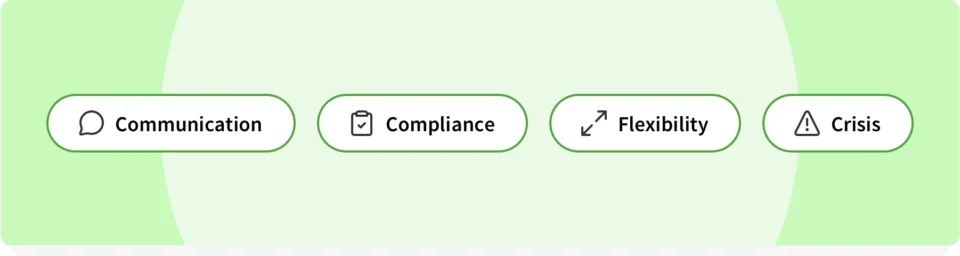
The most common challenges when running a hospital can be broken down into a few categories:
- Communication
Understanding the communication needs, and how they differ between staff that includes doctors, nurses, custodians, and dietary workers, among others, takes a purposeful effort. - Compliance
Federal and state laws for healthcare are constantly changing, as are insurance regulations. Knowing those laws, and being in compliance with all of them for every part of hospital operations, is almost a full-time job on its own. - Flexibility
You have to be flexible on both a daily level in how you manage your meetings and tasks, and on a broader level in the management of the entire hospital organization. Flexible and agile organizations can quickly adapt to change, which is what a hospital needs to be able to do.
That means managing in a way that builds flexibility into the system. Being able to think analytically (and have the data on hand to do that) helps you be more agile and flexible while running a hospital. - Crisis
The “normality” of a crisis in the healthcare setting is one way hospital management is different from any other kind of management.
A hospital crisis can be sudden, come after a slow build, be short-lived, or settle in long-term to the point that you have to figure out a way to manage effectively despite its presence.
Consider the current growing labor shortage directly affecting hospital staffing levels, paired with an increased demand for medical services. Less staff, more demand…crisis.
When I Work can help you manage the intricate details of scheduling healthcare employees that require compliance with important regulations.
Scheduling rules will automatically make sure your staff get enough rest between shifts. Plus, you can use templates for rotating schedules to ensure constant coverage. You can even use custom units to forecast the number of patients or beds you need to cover.
| See how When I Work simplifies healthcare scheduling, check it out! |
Effective hospital management
There’s no one way to manage or run a hospital. Your management style may differ from another. But there are a few basic tips that should help anyone in hospital management.
Tip #1: Prevent healthcare staff burnout
62% of nurses experience burnout. And one of the main keys in how to run a hospital is to prevent burnout.
While it’s valuable to know the warning signs that an employee is about to quit, it’s even more valuable to keep them from getting to that point in the first place.
Some of the ways you can help avoid employee burnout are to pay attention to mental health and make it a top priority that you communicate to your staff.
You should also avoid knee-jerk punitive responses, and, when it comes to scheduling, stop letting the bottom line override your employee’s need for a good work-life balance.
Granted, when it comes to healthcare staff scheduling, some compliance laws make it difficult in your hospital. Other industries have more freedom on how well-staffed shifts are while hospitals don’t always have that kind of leeway.
Using flexible scheduling is a win-win solution, keeping your shifts full while still giving employees more control over their lives.
We know you might not have all of the resources you need to do your job as well as you could, and that you’re having to make do with less than ideal solutions. While the right tools are important, so is avoiding burnout in your own life.
It’s not just nurses and other hospital staff who get hit with burnout. Managers do, too. You carry a lot of responsibility for so many people, sometimes more than you ought to for what should be a team effort.
Pay attention to your own weariness, mental health, and need for a break. Don’t skip breaks, time off, or personal time away from the job because there’s so much to do.
Related read: 5 Ways To Increase Retention In Healthcare
Tip #2: Understand and adapt to changing patient expectations
Patients are changing. Oh, they still have the same medical needs, but their expectation of what happens at the hospital changes.
- More comfortable facilities
- A more relational experience and interaction with your staff
- Availability and access to specialist doctors
- Being more human and less a number and a char
Understandably, you’re working within the limitations of your budget and what administration allows. But listening to patients, and the staff who work with them, will help you understand their experience better.
They may be able to offer suggestions for improvement within the scope of what you can work with or have on hand. Patient surveys or feedback on what could be improved is valuable.
Tip #3: Make ongoing staff training a priority
The healthcare industry is constantly changing. If training your staff isn’t a priority, they aren’t keeping pace with that change.
When new staff is hired, you train them according to what they need to know to do their job.
But what about providing communication or managerial training, even if it’s not directly or obviously linked to their job? Or training them on what being patient-centric looks like? Wouldn’t everyone benefit with an understanding of those processes?
You’ll often see recommendations to create a communication strategy, a patient-centric strategy, or something similar. Yet you can’t develop a functioning communications strategy if the people it affects haven’t been trained how to do it.
You can’t expect all staff to be naturally patient-centric if they aren’t trained to know what that looks like.
Training is how you prepare your staff to meet expectations. It’s hard to strategically plan and manage your team to hit those expectations if your staff doesn’t know how to get there.
Whether it’s in-house or online training, frequently revisit what your staff needs to know. Don’t expect more of your staff than what they’ve been trained to do.
Tip #4: Use hospital scheduling software and technology
The right tools can seriously lighten your management load while running a hospital, particularly with communications and scheduling. The healthcare industry has gotten more complex, more digitized, and more flexible. Are your management tools keeping up?

Scheduling for healthcare staff is notoriously challenging, and tools like When I Work can really help out. It can help you mesh full-time, part-time, and PRN pool workers.
Plus, payroll integrations, the ability to use any device as an employee time clock app, and providing a better work-life balance for your employees are only just a part of what the right tool has to offer. You’re also getting real-time data that helps you spot trends and make strategic decisions.
| Sign up for your free trial today to see how When I Work can help your hospital! Start your free trial |
Tip #5: Build in accountability systems
Creating a system where you can hold all staff accountable for the things they are assigned to do is important to successful management. Creating a management plan that your team doesn’t follow is an exercise in futility (and a waste of your time).
An accountability system should help you spot poor performance. Employees who are underperforming are likely contributing to burnout in others trying to make up for them. Or it can help you see employees who are doing too much and heading for burnout.
That kind of accountability reaches far.
It overlaps with communication. It identifies problem areas, or vulnerabilities, in your system before a crisis hits. It keeps information on staff, rules, and expectations updated and available.
Accountability isn’t a punitive thing. It’s about communicating expectations and helping your whole team meet those expectations together.
Trends shaping hospital management in 2026
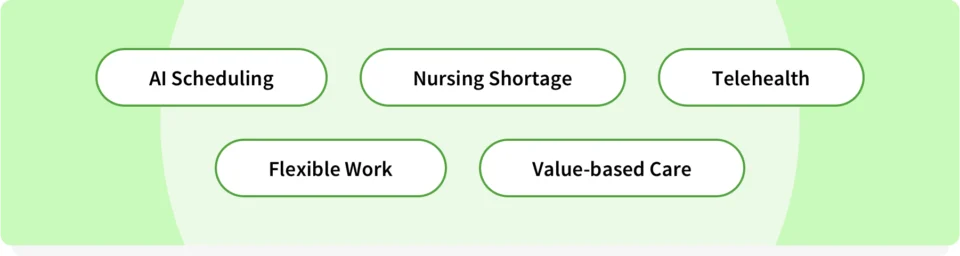
It’s fair to say that after the pandemic, hospital management has changed significantly. And even today, the landscape is different than it was just a year ago. Here are some of the trends that administrators need to be aware of:
- Nursing shortage—What was a generational workforce gap is now an operational crisis. Trying to out-hire the shortage doesn’t work, you have to protect your existing workforce.
- AI-driven scheduling and predictive analytics—This has gone from a pet IT project to standard hospital infrastructure. Modern platforms now analyze patient flow in real time. They also optimize compliant shift schedules based on historical data and seasonal demand.
- Value-based care—Tying financial reimbursement to patient outcomes, rather than patient volume, has made workforce flexibility a key to success. Letting nurses choose their ideal schedules reduces readmission risks and lowers turnover, all while increasing the hospital’s bottom line.
Optimize your hospital management with the help of When I Work
Hospital management, in the post-COVID era, is more difficult yet more important than ever before. While your organization is unique, providing the best patient care starts by caring for your staff first and giving them every tool to be effective.
In what seems to be an out-of-control world, giving employees control over their own work-life balance is incredibly important and, with tools like When I Work, much easier than you think. Contact us today and see how we can help you manage your team to optimal effectiveness.
Hospital management FAQs
Q: What is hospital management and why is it important?
A: Hospital management is the process of overseeing all aspects of a hospital facility, from high-level strategies to day-to-day operations. Its importance is evident in ensuring smooth operations, patient satisfaction, compliance with laws, and managing challenges such as staff shortages and crises.
Good hospital management ensures seamless patient care even amidst challenges.
Q: What are some common challenges faced in hospital management?
A: Some common challenges in hospital management include communication across different staff roles, adhering to ever-changing healthcare compliance laws, ensuring flexibility to adapt to change quickly, and managing crises that can vary in intensity and duration.
Q: How can hospital management combat staff burnout?
A: Hospital management can combat staff burnout by focusing on mental health and communicating its importance to staff, avoiding rash punitive actions, and offering flexible scheduling options.
This helps in maintaining a good work-life balance for employees and can prevent them from feeling overwhelmed or unappreciated.
Q: How can hospital management enhance patient experience?
A: Hospital management can enhance patient experience by understanding changing patient expectations, like more comfortable facilities and human-centric interactions.
Part of knowing how to run a hospital is knowing when to listen to patient feedback and implement relevant suggestions. That can significantly improve the patient experience.
Q: How has the COVID era impacted hospital management?
A: The COVID era has added more challenges to hospital management, with increased patient loads, staff shortages, and evolving healthcare protocols. However, it has also emphasized the importance of effective hospital management in ensuring patient care and staff welfare.
Q: How can hospital management improve work-life balance for its employees?
A: By using tools like When I Work, hospital management can provide flexible scheduling options for their staff. This helps keep shifts well-staffed while giving employees greater control over their personal lives, fostering a healthier work-life balance.
Q: What does a hospital manager do?
A: A hospital manager oversees every aspect of a medical facility, balancing big-picture planning with daily operations.
Q: What skills do hospital managers need?
A: Hospital managers need strong analytical and strategic thinking skills, along with open communication and crisis management abilities. These are all important when managing changing laws, preventing staff burnout, and coordinating different departments.
Q: What’s the difference between hospital management and healthcare administration?
A: Hospital management is all about the active, operational running of a hospital facility. Healthcare administration is more about high-level corporate and clinical governance.
Q: How much does hospital management software cost?
A: Cost always depends on the company, the features you need, and specialized tools. For example, if you use When I Work, pricing starts at $2.50 per user per month.