Scheduling Strategy
When I Work vs Connecteam (2026): Is All-in-One Slowing You Down?

If you’re searching for the Connecteam login or reading Connecteam reviews, you’re likely comparing tools for scheduling, time tracking, and day-to-day coordination across a shift-based team.
Connecteam and When I Work both support frontline workplaces. The difference lies in how each platform approaches workforce management. Connecteam is built as a broad employee operations platform, combining scheduling and time tracking with task management, training modules, HR tools, and internal communication features. When I Work focuses more directly on scheduling, messaging, attendance, and shift coordination, keeping the workflow centered on getting accurate schedules built and published quickly.
Looking for the Connecteam login page? You can access it directly at connecteam.com. If you’re comparing platforms to decide which structure best fits your team, this guide breaks down the practical differences.
For very small teams, Connecteam’s free plan can be an attractive entry point. But for managers who mainly need clean scheduling, labor visibility, and accountability without tackling layered modules, the comparison often comes down to simplicity versus feature breadth.
The Connecteam vs When I Work decision framework
Choosing between Connecteam and When I Work comes down to product scope and day-to-day priorities.
Connecteam offers a broad employee management platform with multiple operational modules. When I Work keeps the focus on scheduling, time tracking, and shift communication, designed for teams that want to manage coverage and labor without managing a layered system.
Choosing between these tools is about matching the software to your operational speed. While Connecteam offers a broad experience, When I Work is designed as a specialized tool for teams where every minute of a shift matters.
| Connecteam | When I Work | |
| Scope | Workforce management platform with scheduling, time tracking, communication, forms, and training modules | Scheduling and time tracking platform with built-in messaging and payroll integrations to connect your schedule and timesheets to payroll and HR tools |
| Free plan | Free plan for up to 10 users | 14-day full-access free trial |
| Base price (Entry tier) | The $29 plan is per hub (Operations, Communications, HR), and stacking hubs increases cost. | All features are included in both plans, they’re based on your business structure $2.50 per user per month for single location or schedule plan, $5 per user per month for multiple locations or schedules |
| Scheduling | Drag-and-drop scheduling, templates, recurring shifts, auto-scheduling tools | Drag-and-drop scheduling, templates, recurring shifts, rule-based auto-scheduling |
| Time tracking | GPS, geofencing, kiosk mode, break and overtime tracking | GPS, geofencing, photo clock-in, break and overtime tracking |
| Payroll integration | Payroll integrations via supported partners | Direct integration with Rippling and other payroll providers |
| Onboarding and training | Built-in onboarding workflows and course builder | 10-minute setup |
| Team messaging | Built-in team chat and announcement tools | Built-in WorkChat for one-to-one and group messaging, announcement features, and automatic notifications for changes and updates |
| Customer base | Serves teams across multiple industries | Used by more than 200,000 shift-based workplaces across all industries |
Understanding Connecteam’s hub structure vs per-user pricing
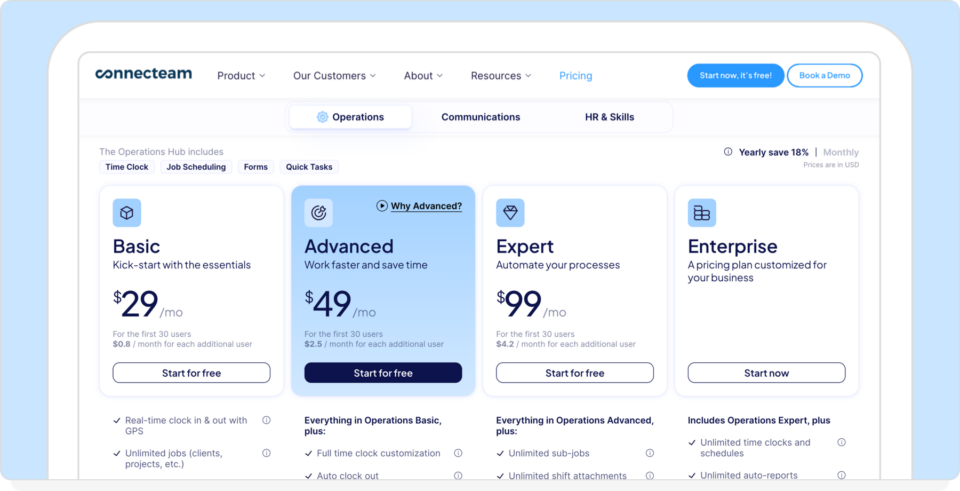
One of the key differences between Connecteam and When I Work is how pricing is structured.
Connecteam organizes its platform into separate product areas called Hubs, such as Operations, Communications, and HR & Skills. Each Hub has its own plan tiers and pricing. Teams that need scheduling, chat, training, and HR tools may need to subscribe to more than one Hub depending on which features they use.
Pricing information from Connecteam’s website March 2026.
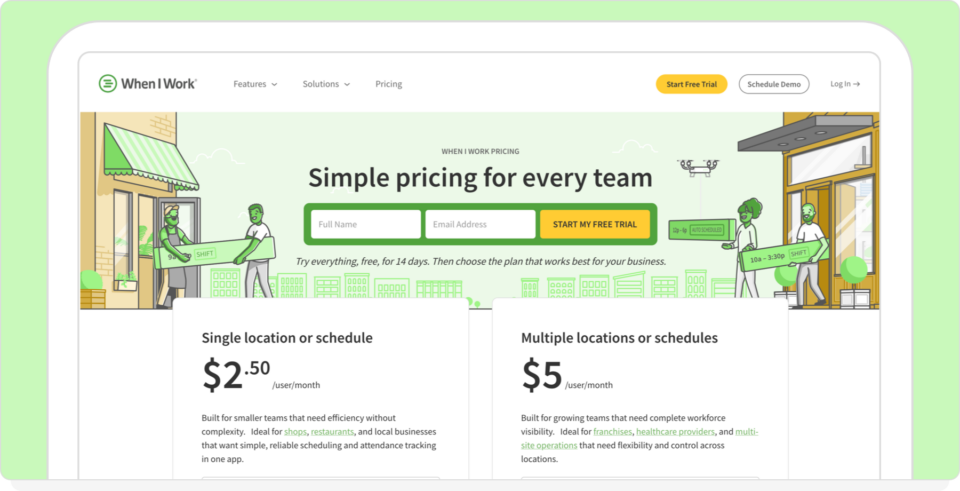
When I Work uses a per-user pricing model. Scheduling, time tracking, and team messaging are included within the same plan rather than separated into product categories. That structure keeps pricing tied directly to headcount rather than feature bundles.
What this means in practice
The key difference is not necessarily price alone, but pricing structure.
- Connecteam pricing allows teams to activate different product areas depending on which tools they want to use.
- When I Work includes core scheduling, time tracking, and messaging together under one per-user price.
For teams that only need basic scheduling, Connecteam’s free plan can be a cost-effective starting point. For teams that rely on multiple operational tools, understanding how different Hubs stack together is part of the comparison.
The decision depends on whether you prefer:
- A modular system where you add feature categories as needed
- A unified per-user structure where scheduling, time tracking, messaging and all other features are included together
Scheduling under pressure: Handling a last-minute call-out
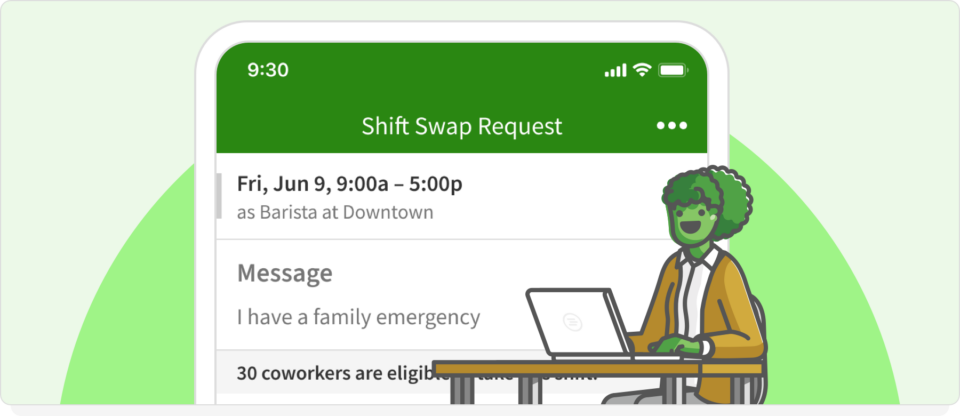
Schedule changes often happen with little notice. One way to compare platforms is to look at how each handles a same-day absence.
Imagine it’s 4:00 PM on a Friday and a team member calls out sick.
Connecteam
Connecteam includes drag-and-drop scheduling, templates, recurring shifts, and auto-assignment tools within its Operations Hub. Managers can review availability, apply rules, and assign open shifts directly in the scheduling module.
Overtime settings and shift controls are configurable depending on the selected Operations plan tier.
If the manager needs to message a group of eligible employees, that functionality sits inside the Communications Hub, which is priced separately from the Operations Hub.
When I Work
When I Work provides drag-and-drop scheduling, recurring shifts, and rule-based auto-scheduling within the same platform used for team messaging. Managers can define availability, qualifications, and labor limits in advance. When a shift opens, eligible employees can be identified and notified directly through the app without switching modules.
Scheduling, time tracking, and messaging operate within the same plan structure.
The When I Work vs Connecteam difference in approach
The difference is not whether both platforms offer scheduling and communication tools. Both do.
The distinction is how those tools are packaged.
- Connecteam separates scheduling and chat into different product Hubs
- When I Work keeps scheduling and shift communication within the same core plan
For teams that mainly need fast shift coordination, the structure of the platform can affect how many layers a manager has to explore during time-sensitive changes.
Attendance verification: Location tracking vs identity confirmation
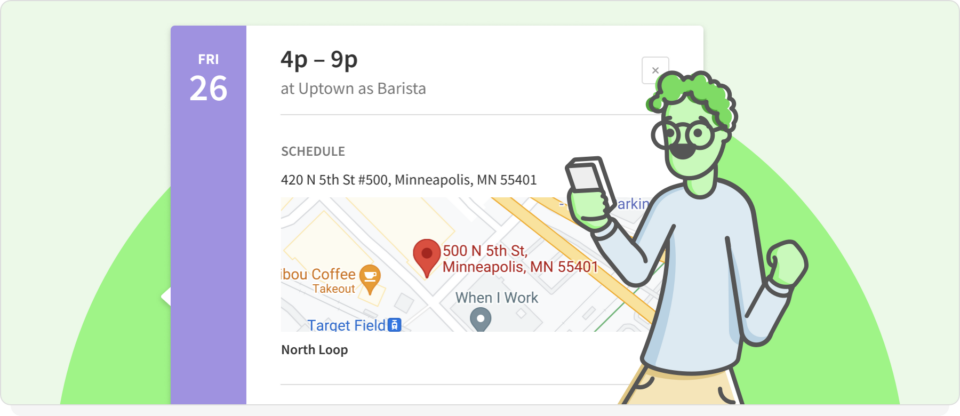
Both Connecteam and When I Work provide tools designed to improve timesheet accuracy. The main difference is how clock-ins are verified.
Connecteam
Connecteam includes GPS tracking and geofencing within its time-tracking system. Managers can view where employees clock in and configure location-based controls depending on the selected plan.
Kiosk mode and additional time clock controls are also available depending on the plan level.
When I Work
When I Work includes GPS-based clock-in verification and photo clock-in functionality. Photo verification requires employees to take a selfie at the time of clock-in, helping confirm that the correct person is starting the shift.
This method is often used by shift-based workplaces where identity verification at the point of clock-in is a priority.
Setup, onboarding, and time to value
When comparing Connecteam vs When I Work, setup structure can influence how quickly teams begin using the platform day to day.
Connecteam Setup
Connecteam provides guided onboarding for configuring its different Hubs, permissions, and policies. Because the platform includes multiple product areas such as Operations, Communications, and HR & Skills, setup depends on which modules are activated.
For teams using scheduling only, configuration may be straightforward. For teams enabling scheduling alongside training, forms, and communication, settings must be configured across multiple areas of the platform.
This structure supports teams that want broader workforce tools in one system.
When I Work setup
When I Work centers on scheduling, time tracking, and team messaging. With a narrower feature scope, many teams configure scheduling settings and begin publishing shifts without worrying about separate product categories.
Managers typically define:
- Employee availability (which employees can also configure)
- Roles and positions
- Scheduling rules
- Overtime settings
Once those are defined, teams can begin generating schedules and tracking attendance.
The difference is not necessarily speed alone, but scope. When I Work requires fewer settings and set-up layers because the platform focuses on shift management rather than broader HR functions.
When I Work vs Connecteam support comparison
Support is another factor in many Connecteam reviews and comparison discussions.
Connecteam support
Connecteam offers:
- 24/7 live chat support
- Phone support options
- A help center and knowledge base
- Community forums
- Availability may vary by plan tier
When I Work support
When I Work provides:
- Online help center and training resources
- Ticket-based support and live chat with a less-than 30-second response time
- In-app support options
For teams that mainly need help with scheduling set-up and payroll integration, these resources are typically sufficient.
Connecteam vs When I Work support overview
The setup decision often comes down to platform scope.
If you’re looking for a broader workforce management platform with multiple HR and operations modules, Connecteam offers a more expansive environment.
If you’re evaluating a Connecteam alternative mainly for scheduling and attendance management, When I Work offers a more focused option.
Neither platform is inherently faster. The timeline depends on the number of features you plan to activate and the complexity of your workforce policies.
Payroll integrations and ecosystem fit
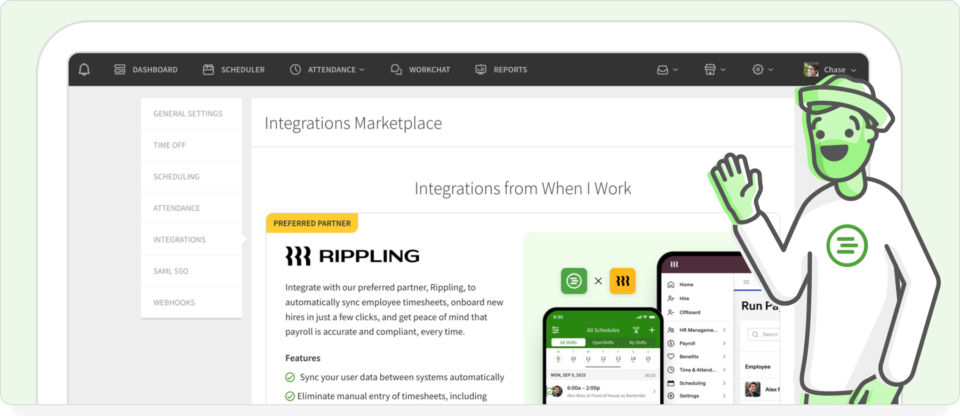
Payroll integration is a key consideration in any Connecteam vs When I Work comparison, especially for teams looking to improve workflows.
When I Work payroll integrations
When I Work integrates with multiple payroll providers, including:
- Rippling (preferred partner)
- ADP
- QuickBooks
- Gusto
- Other supported systems
Rippling is the preferred payroll partner because When I Work syncs directly into Rippling payroll. For teams using ADP, QuickBooks, Gusto, or other providers, When I Work also supports payroll integrations designed to reduce manual entry between systems.
The practical implication is flexibility. Organizations can align payroll integration with their existing payroll infrastructure rather than changing providers.
Connecteam payroll integrations
Connecteam also integrates with several payroll and accounting providers, depending on plan and region.
Like When I Work, Connecteam supports payroll exports and partner integrations to help teams transfer approved timesheets into payroll systems.
Structural difference: Preferred partner vs multi-partner model
For companies already on Rippling, the relationship between When I Work and Rippling may simplify implementation. For companies using other payroll providers, both platforms offer integration options that should be evaluated based on specific payroll and HR system requirements.
Security, compliance, and data handling
Security and compliance are essential considerations in any Connecteam review or workforce software comparison.
Below is a high-level overview based on publicly available documentation as of 2026.
| Category | Connecteam | When I Work |
| Data encryption | AES-256 encryption | Encrypted data transmission |
| SOC 2 | SOC 2 Type II | SOC 2 Type II |
| GDPR | Yes | Yes |
| HIPAA | States HIPAA compliance | Not positioned as HIPAA-compliant |
| Multi-factor authentication | Yes | Yes |
| Hosting regions | Multiple regions | AWS-based cloud infrastructure |
HIPAA considerations
When I Work is designed for staff scheduling, attendance tracking, and team messaging. It’s not intended to store Protected Health Information or function as a clinical record system.
Connecteam states that it supports HIPAA-compliant use cases under specific configurations. Organizations handling PHI should review vendor documentation directly to determine whether the platform aligns with their regulatory obligations.
Promotional offers
From time to time, When I Work offers incentives for eligible new customers. Details vary by promotion and eligibility criteria.
Organizations comparing platforms should confirm current offers directly with each vendor.
How the scope of each platform impacts day-to-day management
Connecteam’s free plan for teams of fewer than 10 users is a clear advantage for very small teams. For businesses looking for a broad workforce platform without upfront cost, it can be an attractive entry point.
The more relevant question is how the platform functions once additional tools are introduced.
Managing multiple modules
Connecteam is structured around separate functional areas, listed as Operations, Communications, and HR & Skills. Teams that use scheduling alongside training, forms, internal messaging, and compliance tools may configure settings across different parts of the platform.
For teams that want HR, communication, and scheduling tools within one system, this structure can be useful. It consolidates multiple workforce functions under one account.
For teams focused on scheduling efficiency and labor visibility, managing those additional modules can feel unnecessary if the tools are not part of daily workflow.
Feature breadth vs scheduling focus
Connecteam offers a wide range of tools, including:
- Scheduling
- Time tracking
- Forms and checklists
- Training modules
- Internal communication
- Employee recognition features
When I Work keeps its scope centered on:
- Shift scheduling
- Time and attendance
- Messaging connected directly to shifts
- Payroll alignment
The trade-off is clear:
- Connecteam provides a broad workforce platform with scheduling, forms, training, communication, and HR tools inside one system.
- When I Work focuses on scheduling, attendance tracking, and team coordination, while connecting to payroll providers through integrations and preferred partners such as Rippling.
For organizations that want a single platform covering many operational tools (and are happy to pay for the extra functionality), Connecteam’s broader feature set may be appealing. However, that breadth also means scheduling sits alongside many other modules. Connecteam’s focus is spread across multiple feature sets, without really concentrating on the core needs of a shift-based workplace.
When I Work takes a different approach. By specializing in scheduling and attendance workflows, the platform keeps the day-to-day process of building schedules, filling shifts, and tracking hours simpler for managers. Payroll and HR systems can then connect through integrations rather than being bundled into the scheduling software itself.
If your priority is building schedules quickly, reducing administrative layers, and keeping the interface focused on shift coordination, a more scheduling-centered system may align better with those needs.
Final verdict: Connecteam vs When I Work in 2026
When comparing Connecteam vs When I Work, the decision comes down to scope and day-to-day priorities.
Both platforms support shift-based teams with scheduling, time tracking, and messaging. The difference is how broad you want your workforce system to be.
Choose Connecteam if:
- You prefer a modular system organized into separate product areas
- You value a free plan for very small teams
- You want a single platform that includes broader employee management features
Connecteam’s strength is breadth. It provides a wide range of workforce tools under one account.
Choose When I Work if:
- Your focus is on shift scheduling, attendance tracking, and labor visibility
- You want scheduling and messaging connected within the same workflow
- You prefer a per-user pricing structure rather than separate product categories
- You’re looking for a Connecteam alternative centered on scheduling clarity
The strength of When I Work is focus and ease of use to save you time. It keeps scheduling, attendance, and payroll alignment at the center of the platform.
The bottom line
If your priority is managing multiple workforce functions inside one broad platform, Connecteam may be the right fit.
If your priority is building schedules quickly, reducing administrative layers, and keeping shift coordination simple, a scheduling-centered system may be a better match.
The decision ultimately comes down to whether you want breadth across workforce functions or depth in scheduling and attendance.
Connecteam vs When I Work: Frequently asked questions
When comparing Connecteam vs When I Work, most managers have practical questions about pricing structure, scheduling tools, and day-to-day usability. Below are common questions from teams evaluating Connecteam alternatives or deciding between the two platforms.
Is When I Work better for high-velocity teams than Connecteam?
It depends on what your team needs most. When I Work is built around scheduling, attendance, and shift communication. Managers who spend most of their time building schedules, adjusting coverage, and monitoring labor visibility may prefer a system that keeps those tools tightly connected.
Connecteam includes scheduling within a broader platform that also covers communication, training, forms, and HR functions. For teams that want those tools inside the same system, that breadth can be valuable.
If your main concern is scheduling clarity and minimizing admin time during daily shift changes, a scheduling-focused platform may feel more direct. If your goal is centralizing multiple workforce functions, a broader platform may align better.
How does the When I Work auto-scheduling compare to Connecteam?
Both platforms offer scheduling automation tools. Connecteam provides scheduling templates, recurring shifts, and auto-assignment features within its scheduling Hub. Managers can build schedules using saved structures and configured rules.
When I Work offers rule-based auto-scheduling that factors in availability, roles, and defined labor settings when generating schedules.
The difference is less about whether automation exists and more about how scheduling sits within the overall platform structure.
Is When I Work the best Connecteam alternative for scaling teams?
Often, yes. As teams grow, scheduling complexity usually increases before anything else. More employees, more shift swaps, and more last-minute coverage requests all place pressure on the scheduling workflow.
While Connecteam alternatives often try to replicate its all-in-one feature set, When I Work focuses on the core work of scheduling, messaging, attendance, and payroll. Managers frequently switch when a broader workforce platform begins to feel unnecessarily complex for day-to-day scheduling tasks.
When I Work is designed to keep that process simple. Build the schedule, notify the team, track attendance, and fill open shifts quickly. For teams managing larger schedules or frequent shift changes, that focus can make the system easier for managers and staff to adopt. Connecteam’s broader platform can feel like overkill when you just need to fill a shift in 30 seconds.
How does When I Work pricing compare to the Hub model?
Connecteam pricing is modular, meaning you pay for separate hubs (Operations, Communications, and HR). A 25-employee company that requires a schedule, team chat, and a time clock often ends up paying for three separate subscriptions. When I Work uses a transparent per-user model starting at $2.50 per month, offering scheduling and messaging in a single plan without the siloed billing of a multi-hub suite.
What do Connecteam reviews say about app complexity?
Many Connecteam reviews praise the app’s completeness but highlight a “steep learning curve” and occasional clutter. Because it handles everything from training to surveys, the interface can become overwhelming for frontline staff. In contrast, When I Work is designed for fast adoption, with an intuitive interface that staff can use in minutes, resulting in higher shift-acknowledgement rates.
Looking for the Connecteam login? Here’s why it matters.
If you’re searching for the Connecteam login but find yourself spending more time managing the app than managing your team, it may be a sign of app fatigue. Many teams find that having every feature isn’t as valuable as having a high-speed workflow. When I Work allows you to log in, fill a shift, and approve a timesheet in a fraction of the time it takes to explore a multi-module suite.
Does When I Work offer a free plan like Connecteam?
Connecteam offers a free plan for teams with fewer than 10 users, while When I Work is a paid platform starting at $2.50/user, though it offers a 14-day free trial. When I Work eliminates the feature gates common in free tiers. We provide rule-based auto-scheduling and advanced labor forecasting as core pillars of the platform.
Why are managers switching to When I Work as a Connecteam alternative?
The most common reason for switching is app fatigue. Managers often find that while Connecteam “does everything,” the interface becomes difficult for frontline staff to manage day to day. When I Work provides a focused, intuitive experience that staff can adopt in minutes, resulting in higher shift-acknowledgement rates and cleaner attendance data.
What is the Rippling six-month free offer?
Since Rippling is a When I Work preferred partner, eligible new customers can currently unlock six free months of Rippling payroll, HR, and IT services. It provides a native payroll sync that can turn your When I Work schedule into completed payroll in minutes and keep employee data synced between systems, an offer that third-party integrations simply cannot match.
Reclaim Your Sunday nights with rule-based scheduling
When I Work was built to eliminate the burden of Sunday night scheduling admin. By moving from a manual drag-and-drop system to a rule-based software, you’re getting 15 hours of your life back every single week.
- Instantly fill shifts. Stop the endless “can you work?” text chains. Post an open shift and let your qualified, available staff claim it in seconds.
- Protect the budget. See your labor costs and overtime risks before you publish. Our system alerts you the moment a schedule threatens your margins.
Join over 200,000 shift-based workplaces that have already traded scheduling chaos for operational clarity.
Start your 14-day trial of When I Work and build your first automated schedule today.
Disclaimer: Connecteam feature and pricing information is based on publicly available documentation and user reviews from sources such as G2 and Capterra (accessed February 2026). This comparison is based on publicly available information and product documentation at the time of writing. Features, pricing, and functionality may change over time. While we aim to present accurate and up-to-date information, we recommend reviewing each provider’s official website for the most current details.